
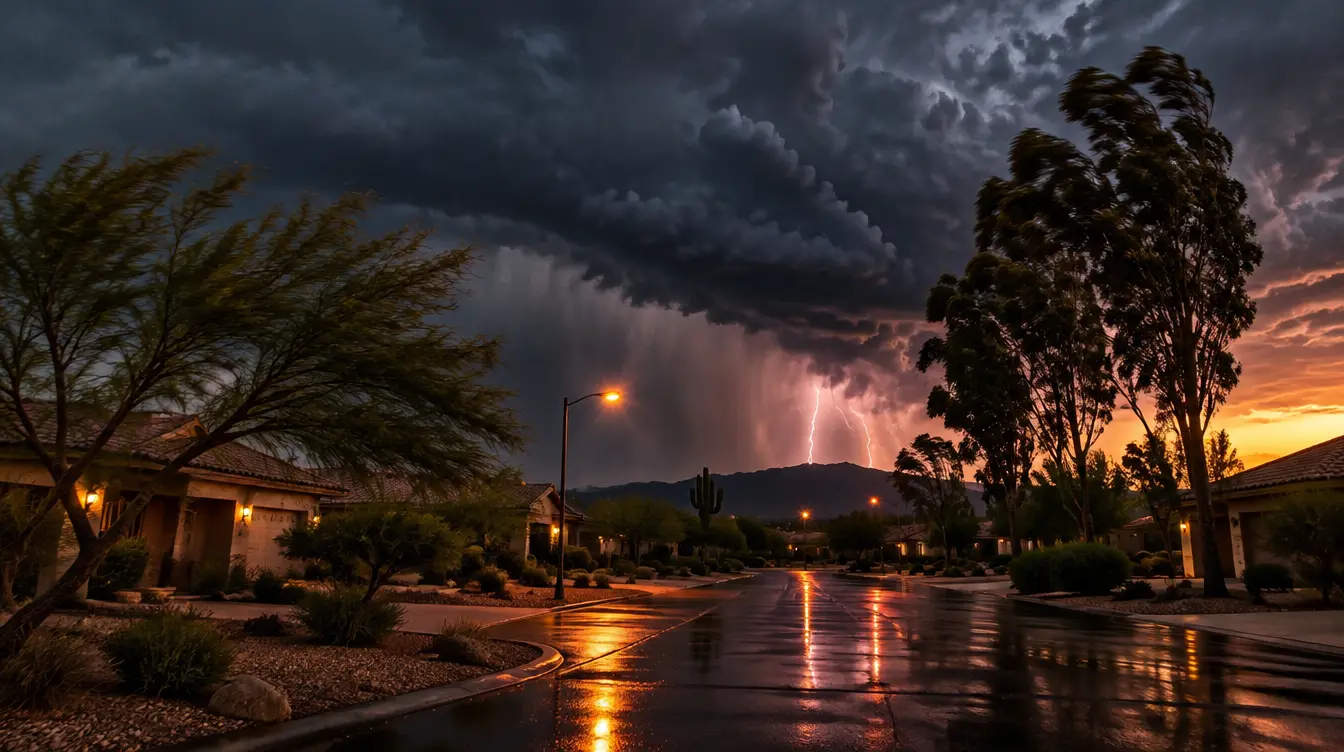
What should I do if a tree falls on my house during a monsoon?
After the storm passes, work through these steps in order:
- Stay safe. Keep people and pets out of the area. A tree resting on a roof or wall is under tension and can shift without warning.
- Treat every downed line as live. Don't touch the tree, the line, or anything the line is resting on, including wet ground or a chain-link fence. Report it to your utility right away.
- Document everything. Take wide photos and close-ups of the tree, the damage and the roots or break point before anything is moved. Insurers usually want to see the condition before cleanup.
- Call your insurance company. Ask what they cover and whether they need an adjuster to look before the tree is removed.
- Call for removal. Reach AZ Grown Tree Care at 480-779-4349. Emergency availability: 24 to 48 hours.
- Prevent more damage. If the roof is open, a roofer can tarp it once the tree is off.
Please don't try to cut a tree off a roof or wall yourself. Limbs under load can spring or roll when cut, and that is how storm cleanup injuries happen.
Why do so many trees fall during East Valley monsoons?
Arizona's monsoon season runs from June 15 to September 30, according to the National Weather Service, and the East Valley sees its share of dust storms and microbursts. The trees that fail most often share a few traits:
- Dense, unthinned canopies. Fast-growing irrigated mesquite and sissoo act like sails if they haven't been thinned.
- Shallow roots. Frequent, shallow watering keeps roots near the surface, and caliche layers can stop roots from going deep. Soaked soil then lets the root plate lift.
- Weak branch unions. Co-dominant stems with bark trapped between them are common split points.
- Heavy, end-weighted limbs. Lion-tailed trees, stripped on the inside, carry all their weight at the tips.
- Hidden decay or borer damage. Palo verdes weakened by root borers and trees with internal rot can fail in moderate wind.
Most of these can be addressed before storm season. See our tree trimming page for how structural pruning and crown thinning reduce wind load.
Does homeowners insurance cover storm tree removal in Arizona?
This is general guidance, not insurance advice. Your policy and your insurer have the final word. Questions worth asking your agent:
- Is removal covered when a tree damages the house, a detached structure or a fence?
- Is there a dollar limit per tree or per claim for debris removal?
- Does it matter whose tree it was? A neighbor's tree falling on your property is often handled differently than your own tree.
- Do they need an adjuster on site before the tree is moved?
- How does your deductible apply?
We can help with the paperwork side. We'll take photos before, during and after the work and give you a written, itemized invoice to submit with your claim. If you're an HOA or property manager dealing with damage across common areas, see HOA and commercial tree care.
How much does storm tree cleanup cost?
A storm doesn't change our pricing approach. You see a written quote before we start, and the price doesn't change after the fact. What affects the cost of storm work:
- What the tree is resting on. A tree lying across an open yard is far simpler than one hung up on a roof, patio cover or block wall, which needs slow, rigged removal.
- Tension and hazards. Split trunks and twisted limbs store energy and must be cut in a careful sequence.
- Size and wood weight. Large mesquite and eucalyptus are heavy and slow to process.
- Access. Debris in backyards, pools and side yards takes more labor to get out.
- Stump grinding. If the tree uprooted or snapped low, grinding or root ball extraction is quoted separately after an on-site look.
Haul-away and clean-up are included. There is a $250 minimum. For more on what drives the price, see our tree service cost guide.
How can I prepare my trees for monsoon season?
A pre-monsoon checklist for East Valley homeowners:
- Thin dense canopies. Mesquite, sissoo and other fast growers should be thinned so wind passes through, not lion-tailed. See tree trimming.
- Take out deadwood. Dead limbs are the first things to fly in a microburst.
- Check over-the-house limbs. Branches over roofs, pools and walls deserve a close look.
- Water deep, not often. Deep, infrequent watering encourages deeper roots. University of Arizona Cooperative Extension and AMWUA publish watering guides for desert trees.
- Look at the base. Mushrooms, cracks, soil heaving or borer exit holes at the base are reasons to call before storm season.
- Re-stake or un-stake. Young trees need loose, temporary staking. Old ties that cut into the bark should come off.
- Palms too. Dead fronds become projectiles. See palm tree trimming.
Spring appointments fill up as monsoon season approaches, so it helps to schedule early.
Our monsoon & storm tree cleanup process
- Make it safeKeep everyone clear. If lines are down, call 911 and your utility before anything else.
- Call AZ GrownCall 480-779-4349. Emergency availability: 24 to 48 hours. Photos help us plan before we arrive.
- Assess and quoteWe check what the tree is resting on, where the tension is, and access, then give you an upfront quote.
- Controlled removalLimbs and trunk are cut in a safe sequence and lifted or lowered off structures to avoid further damage.
- Clean-up and recordsDebris is hauled away, and you get photos and an itemized invoice for your insurance claim.