Trees in Queen Creek: what's different here
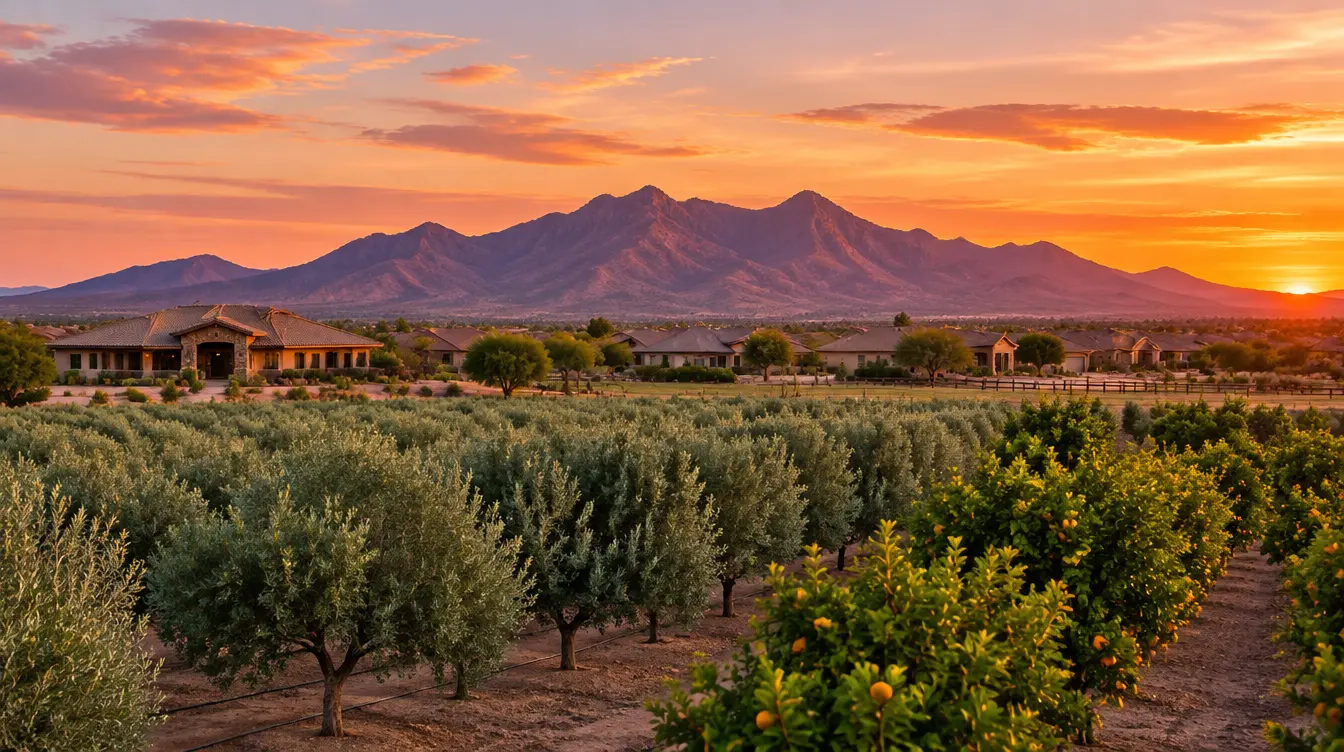
Queen Creek still feels like the farm town it grew from. The Queen Creek Olive Mill and Schnepf Farms anchor an agricultural district, and the Harvest community sits right next to them. Olive and citrus trees show up in yards across town, and larger lots and horse properties often have mature mesquite, eucalyptus and other trees planted as windbreaks back when the land was farmed.
The town is also one of the fastest-growing in the East Valley, with master-planned communities like Hastings Farms, Cortina and Barney Farms full of young trees. Queen Creek sits mostly in Maricopa County, but its limits extend into Pinal County to the east and south, including Ironwood Crossing and parts of Encanterra. Your town services are the same, but county-level matters may differ by parcel.
Trees we care for most in Queen Creek
- Olive
- Citrus
- Mesquite
- Palo verde
- Eucalyptus
- Date palm
- Mexican fan palm
- Sissoo
- Ironwood
Neighborhoods we serve
- Encanterra
- Harvest
- Hastings Farms
- Cortina
- Barney Farms
- Ironwood Crossing
What tree services does AZ Grown offer in Queen Creek?
Queen Creek properties range from compact new-build lots to multi-acre horse properties, so the work looks different from one street to the next.
- Tree trimming and pruning: thinning large mesquite, olive and citrus care, and structural pruning for young trees in new communities.
- Tree removal: dead or declining farm-era trees, storm-damaged trees, and trees too close to homes, barns or fences.
- Palm tree trimming: date palms and Mexican fan palms at entries, pools and along driveways.
- Stump grinding: including large stumps on acreage, so you can reclaim pasture or yard.
- Storm and monsoon cleanup: downed limbs across driveways, fences and arenas.
- HOA and commercial tree care: common areas, parks and entry plantings.
We walk the property with you, explain options in plain English, and put the scope and price in writing. Call 480-779-4349 or request a free estimate.
How do you handle tree work on Queen Creek acreage and horse properties?
Larger Queen Creek properties come with their own set of tree challenges. Many trees were planted decades ago, before the houses around them, and have grown without much maintenance.
Common acreage jobs
- Windbreak rows: older eucalyptus and similar trees along property lines that drop heavy limbs and bark.
- Big native and irrigated mesquite: canopies that need thinning and deadwood removal before monsoon.
- Clearance: raising low limbs over driveways, trailer parking, arenas and RV pads.
- Fence and barn protection: removing limbs that threaten fences, shade structures and stalls.
- Dead tree removal: trees that declined when farm irrigation stopped.
Working safely around animals
Let us know about horses, livestock or dogs. We plan around feeding times and ask that animals be secured away from the work zone, since chainsaws and falling limbs can spook them.
Access
Open acreage often allows better equipment access than a walled yard, which can make large removals more efficient. Soft ground after irrigation or rain may require scheduling around dry conditions. Learn more on our tree removal page.
How should olive trees in Queen Creek be pruned?
With the Queen Creek Olive Mill nearby and olives in many local landscapes, olive trees are part of the town's character. They are tough, drought-tolerant and long-lived, but they need regular attention.
Pruning goals for olives
- Open the center: thinning lets light in and reduces the dense, heavy canopy olives develop.
- Remove suckers: olives sprout heavily from the base and trunk.
- Control size: reduce height gradually instead of topping, which leads to dense regrowth.
- Clear structures: keep limbs off roofs, walls and pool areas, where fruit stains hardscape.
Fruit and pollen
Fruiting olives drop dark fruit that stains concrete and pavers, and olive pollen is a well-known spring allergen in Arizona. Some Valley cities, including Phoenix, restrict planting pollen-producing olive trees, so if you plan to replace an olive, check current Town of Queen Creek and HOA rules and consider a fruitless variety.
When to remove
If an olive is declining, badly split or heaving hardscape, removal and stump grinding may make sense. See tree trimming for more on pruning approach.
Do young trees in new Queen Creek communities need trimming?
Much of Queen Creek's housing is new, and so are its trees. That is an opportunity: shaping a young tree is quick, inexpensive and sets it up for decades.
What we look for on young trees
- Two or more competing leaders that will split later.
- Narrow V-shaped branch unions with bark trapped between them.
- Low branches that will block sidewalks, driveways or views.
- Nursery stakes and ties that are rubbing or girdling the trunk.
- Top-heavy growth from frequent, shallow drip watering.
Watering for strong roots
The University of Arizona Cooperative Extension recommends deep, infrequent irrigation that wets the soil to the edge of the canopy. As trees grow, drip emitters should be moved outward, not left at the trunk. Deeper roots mean better anchoring in monsoon winds.
HOA rules
Front-yard trees in master-planned communities are often part of the approved landscape plan. Check your HOA guidelines before removing or replacing one. For associations, see HOA tree care.
Does it matter if my Queen Creek home is in Maricopa or Pinal County?
The Town of Queen Creek lies mostly in Maricopa County, but its limits extend into Pinal County on the east and south. Neighborhoods such as Ironwood Crossing are on the Pinal side, and Encanterra, a gated Trilogy community, includes homes in Pinal County.
What stays the same
- Town of Queen Creek services and codes apply to homes inside town limits regardless of county.
- Your HOA's landscape guidelines apply as usual.
- AZ Grown Tree Care serves both sides of the county line the same way.
What can differ
- Property tax, assessor records and some county-administered programs.
- Rules for properties just outside town limits, which fall under county jurisdiction.
- Agencies to call for roads and right-of-way outside the town.
When in doubt, check your parcel with the Town of Queen Creek or the county assessor before major removals, especially for trees near streets, washes or shared property lines. We are glad to provide a written scope for any approvals you need. Request a free estimate.
How much does tree service cost in Queen Creek?
In Queen Creek, the biggest price swing is usually between a small subdivision lot and a large property with many mature trees. Factors that affect your quote:
- Tree size and number: windbreak rows and multiple large mesquite take more time.
- Access: open acreage can be easier for equipment; walled yards mean more hand work.
- Debris volume: large canopies generate a lot of material, and hauling is always included.
- Nearby structures: barns, fences, pools and roofs require careful rigging.
- Stumps: grinding is quoted separately after an on-site look.
Acreage and large debris loads are priced after a walk of the property.
For several trees on one property, a single visit is usually the most efficient. See the tree service cost guide.
Our services in Queen Creek
- Tree Trimming & Pruning in Queen Creek: Structural pruning, crown thinning and clearance cuts for mesquite, palo verde, ironwood and more.
- Tree Removal in Queen Creek: Safe, controlled removal of dead, leaning or problem trees, even in tight backyards beside walls and pools.
- Palm Tree Trimming in Queen Creek: Frond trimming, seed-pod removal and clean-up of loose leaf bases for date palms, Mexican fan palms and more.
- Stump Grinding in Queen Creek: Grind stumps below grade so you can replant, lay gravel or pour hardscape. Grindings cleaned up.
- Monsoon & Storm Tree Cleanup in Queen Creek: Fallen trees, split limbs and storm debris cleared safely after monsoon microbursts and dust storms.
- HOA & Commercial Tree Care in Queen Creek: Scheduled pruning, palm trimming and removals for HOA common areas, streetscapes and commercial sites.
- Sissoo Tree Removal in Queen Creek: Removal of sissoo trees whose surface roots are lifting pavers, cracking pool decks and invading pipes.