
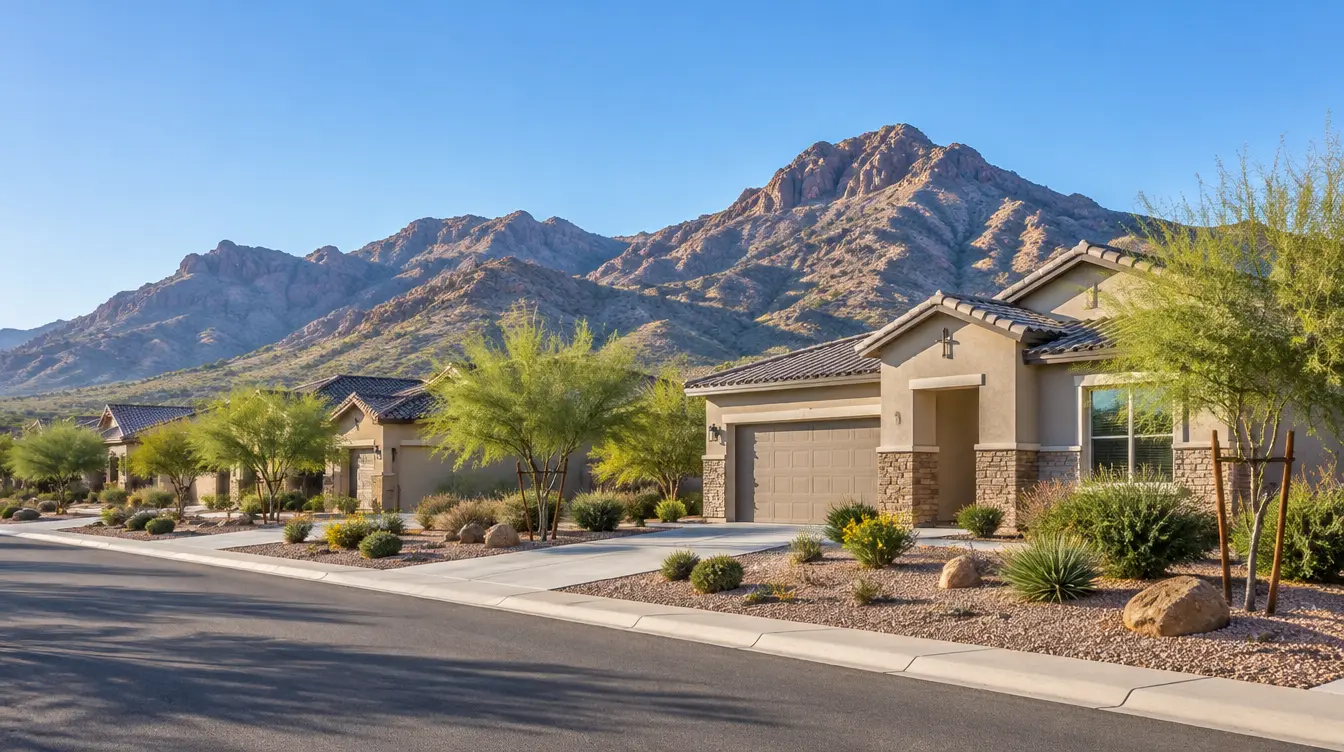
Trees in San Tan Valley: what's different here
San Tan Valley is one of the youngest large communities in Arizona, and its landscapes are young too. Most neighborhoods were built in the last couple of decades, so many trees are builder-planted mesquite, palo verde, acacia and sissoo that have grown quickly on drip irrigation and are now big enough to cause problems if they were never structurally pruned.
Soil is the other big factor. Caliche, a cement-like layer of calcium carbonate, sits close to the surface in many San Tan Valley yards. It blocks deep rooting and drainage, which leaves trees shallow-rooted and prone to tipping in monsoon microbursts. San Tan Valley voted to incorporate in 2025, so local rules are still taking shape; depending on your address, you may be in the new town or in unincorporated Pinal County.
Trees we care for most in San Tan Valley
- Mesquite
- Palo verde
- Sissoo
- Mexican fan palm
- Date palm
- Citrus
- Acacia
- Ironwood
Neighborhoods we serve
- Johnson Ranch
- Pecan Creek
- Skyline Ranch
- Copper Basin
- Rancho Bella Vista
Recent work in San Tan Valley
Before and after photos from Dale's own recent job in San Tan Valley. See every job photo.
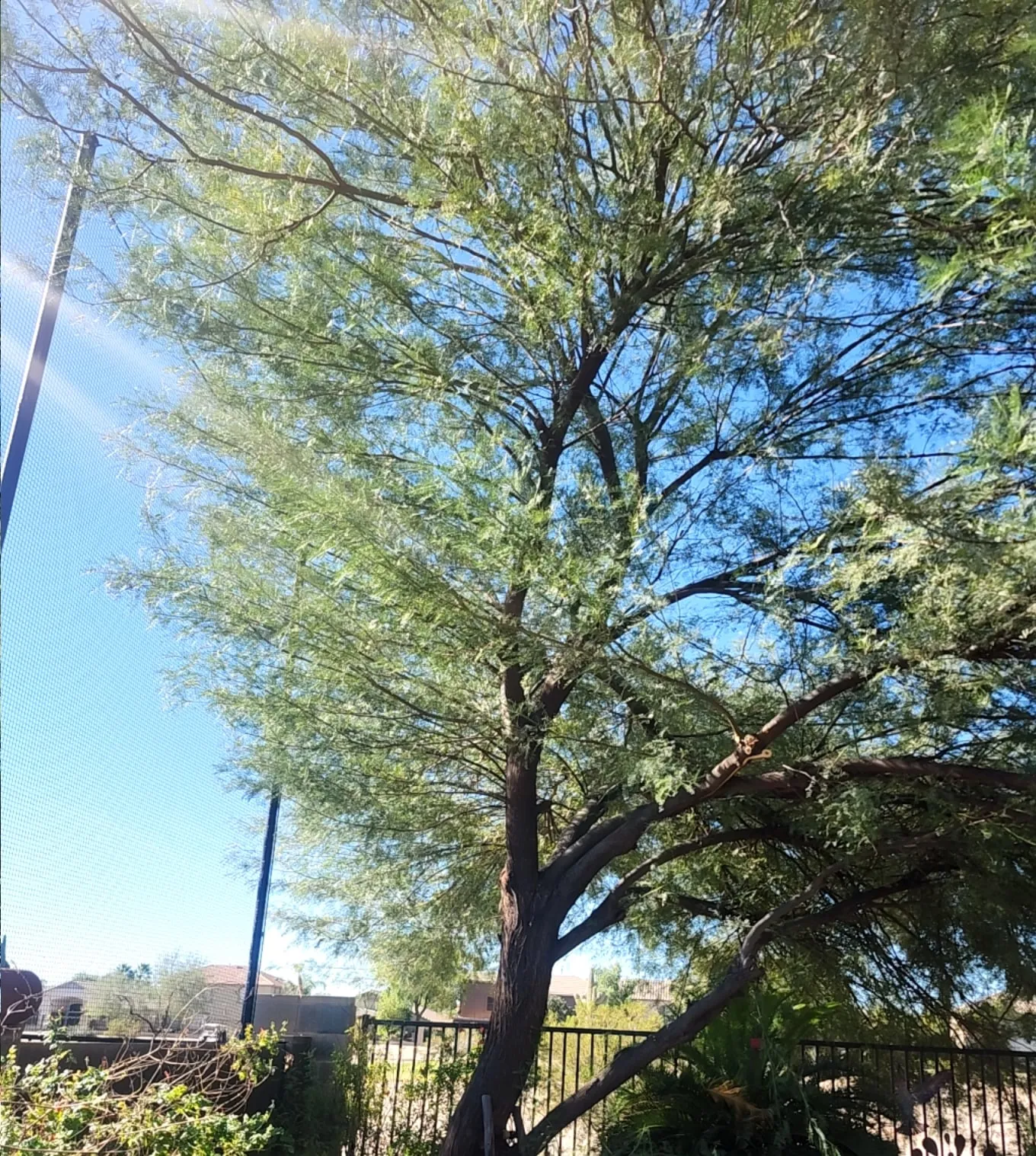 Before
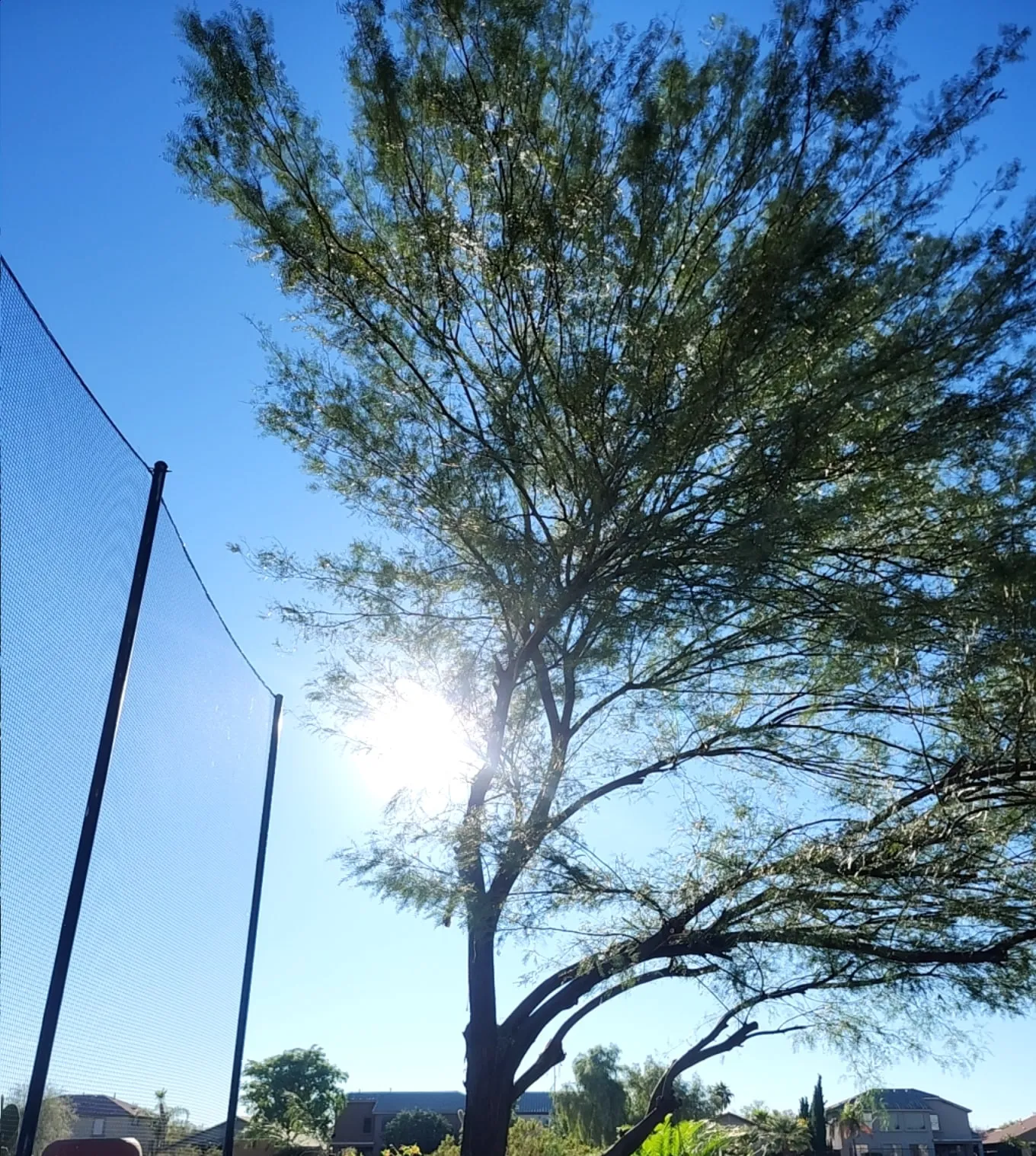 After
What tree services does AZ Grown offer in San Tan Valley?
San Tan Valley calls tend to fall into a few categories: young trees that have grown too fast, trees knocked over by monsoon winds, and yards being re-landscaped.
- Tree trimming and pruning: structural pruning and thinning for builder-planted mesquite, palo verde and acacia.
- Tree removal: leaning, storm-damaged or poorly placed trees close to walls, foundations and pools.
- Storm and monsoon cleanup: uprooted and split trees after summer storms.
- Stump grinding: clearing stumps so you can replant or redo rock and turf.
- Sissoo removal: for roots that crack hardscape and break irrigation lines.
- Palm tree trimming: annual frond and seed-stalk cleanup.
- HOA tree care: greenbelts, parks and entry plantings.
We serve the whole San Tan Valley area, including homes near San Tan Mountain Regional Park. Call 480-779-4349 or request a free estimate.
Why do trees in San Tan Valley blow over during monsoon storms?
Every monsoon season brings calls about trees lying across yards, walls and driveways in San Tan Valley. The causes are usually a combination of three things.
1. Caliche
Caliche is a hard, cemented soil layer common across Pinal County. When it sits a foot or two below the surface, roots spread sideways instead of down, and water can pool around the root zone after heavy rain, softening the soil right when winds are strongest.
2. Shallow irrigation
Drip emitters placed near the trunk and run frequently for short periods train roots to stay shallow and close. The University of Arizona Cooperative Extension recommends deep, infrequent watering that reaches the edge of the canopy.
3. Dense, unpruned canopies
Builder-planted mesquite, acacia and sissoo grow fast. Without thinning, they become top-heavy and catch wind.
What helps
- Thin dense canopies before monsoon season, which typically starts mid-June.
- Move drip emitters outward as trees grow and water deeply.
- Remove builder stakes once trees are established.
- Have leaning trees assessed early, before a storm decides for you.
If a tree is already down, see our storm cleanup page.
How should young trees in San Tan Valley be pruned?
Because most San Tan Valley neighborhoods are relatively new, many yards have trees in the five-to-fifteen-year range. This is the best window to shape them.
Structural pruning checklist
- Pick one leader: reduce competing trunks so one main stem dominates.
- Fix weak forks: shorten one side of tight V-shaped unions.
- Space scaffold limbs: remove crowded or crossing branches.
- Raise gradually: lift low limbs over walkways a little at a time, not all at once.
- Remove stakes: builder stakes and ties left too long rub or girdle trunks.
Species notes
- Mesquite: grows fast and dense; thin regularly, especially before monsoon.
- Palo verde: prune lightly; avoid big cuts on the green bark.
- Acacia: often multi-trunked and prone to splitting; watch for weak unions.
The ISA's TreesAreGood.org has helpful homeowner guides on young-tree pruning. For hands-on help, see our tree trimming page.
Who sets tree rules in San Tan Valley now that it is a town?
For years, San Tan Valley was a large unincorporated area governed by Pinal County. In August 2025, voters approved incorporation, and the Town of San Tan Valley was formally established in September 2025. Under an agreement with the county, Pinal County continued providing services through July 2026 while the new town set up its operations.
What that means for homeowners
- Town or county: not every home with a San Tan Valley address is inside the new town limits. Some areas remain unincorporated Pinal County.
- Codes are evolving: the town may adopt its own rules on right-of-way, nuisance vegetation and landscaping over time. Check current requirements before major work near streets or sidewalks.
- HOAs still matter most day to day: communities like Johnson Ranch, Pecan Creek and Skyline Ranch have landscape guidelines and maintain their own greenbelts and common areas.
Our approach
We do not guess at rules. We provide a written scope you can share with your HOA or the town, and we recommend confirming any requirements before removing street-facing or common-area trees. For associations, see HOA tree care.
Can you plant a new tree where a stump was ground in caliche soil?
Re-landscaping is common in San Tan Valley as original builder plantings age out or get damaged in storms. Here is what to know before replanting.
After stump grinding
- Grinding leaves wood chips and mulch mixed with soil. Remove most of it before planting, since decomposing wood ties up nitrogen.
- Large lateral roots from the old tree remain underground and decay slowly.
- Planting slightly offset from the old stump is often easier.
Dealing with caliche
- Dig the hole wider rather than deeper, usually two to three times the root ball width.
- Test drainage by filling the hole with water. If it is still full the next day, there is likely a caliche layer.
- Break through or drill a drainage chimney through the caliche so water can escape.
- Backfill with native soil; heavy amendments can create a "bathtub" effect.
Choosing a replacement
Desert-adapted trees such as thornless mesquite, palo verde varieties and ironwood suit the area, and the University of Arizona Cooperative Extension publishes guidance on choosing desert-adapted trees. See stump grinding for details on our process.
How much does tree service cost in San Tan Valley?
Many San Tan Valley jobs involve small to mid-size trees, which keeps costs manageable, especially when you address problems early.
- Preventive pruning costs less: structural pruning on a young tree is far cheaper than removing a split or toppled one later.
- Access: walled backyards with a single side gate take more labor than front-yard work.
- Storm work: toppled trees tangled in walls or fences take more time to remove safely.
- Multiple trees: combining several trees in one visit is usually more efficient.
A proper estimate comes from seeing the tree on site.
Every quote is written and itemized. See the tree service cost guide or request a free estimate.
Our services in San Tan Valley
- Tree Trimming & Pruning in San Tan Valley: Structural pruning, crown thinning and clearance cuts for mesquite, palo verde, ironwood and more.
- Tree Removal in San Tan Valley: Safe, controlled removal of dead, leaning or problem trees, even in tight backyards beside walls and pools.
- Palm Tree Trimming in San Tan Valley: Frond trimming, seed-pod removal and clean-up of loose leaf bases for date palms, Mexican fan palms and more.
- Stump Grinding in San Tan Valley: Grind stumps below grade so you can replant, lay gravel or pour hardscape. Grindings cleaned up.
- Monsoon & Storm Tree Cleanup in San Tan Valley: Fallen trees, split limbs and storm debris cleared safely after monsoon microbursts and dust storms.
- HOA & Commercial Tree Care in San Tan Valley: Scheduled pruning, palm trimming and removals for HOA common areas, streetscapes and commercial sites.
- Sissoo Tree Removal in San Tan Valley: Removal of sissoo trees whose surface roots are lifting pavers, cracking pool decks and invading pipes.