
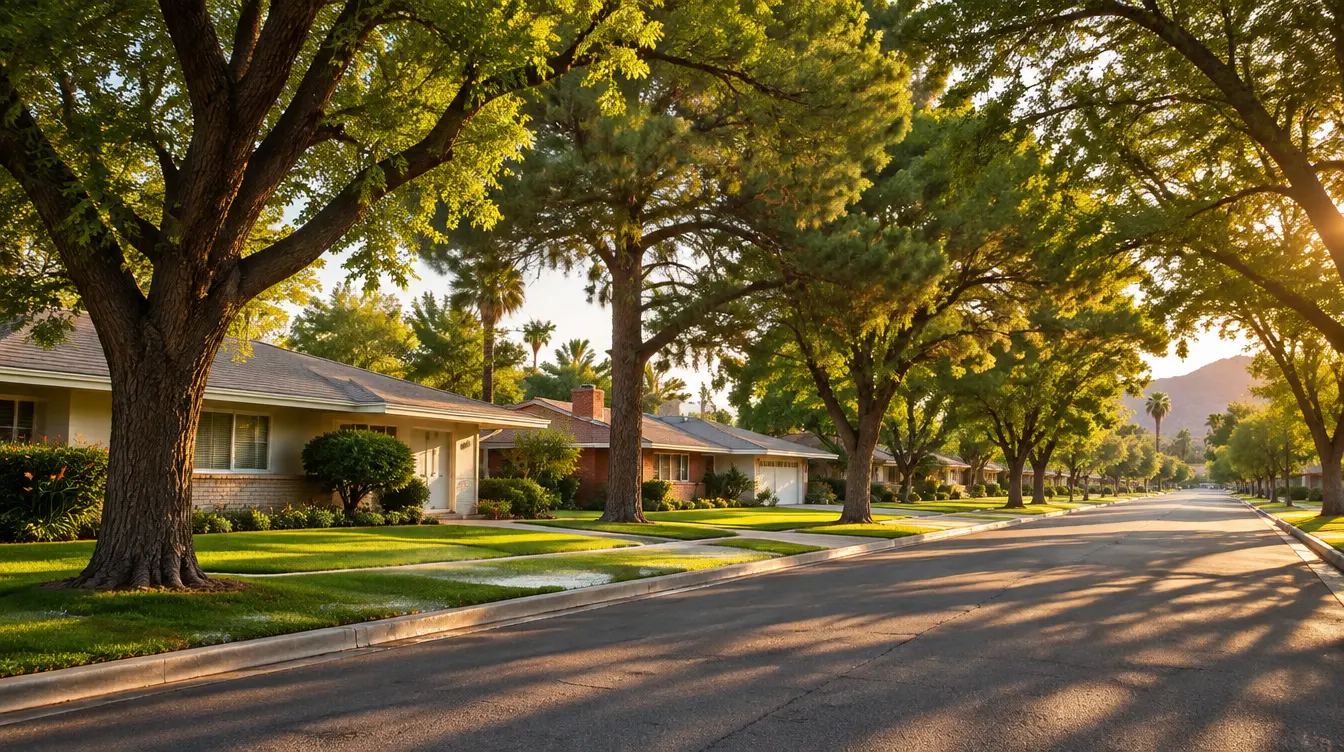
Trees in Tempe: what's different here
Tempe is one of the Valley's older, mostly built-out cities, and that shows in its canopy. North Tempe neighborhoods near downtown and Arizona State University, such as Maple-Ash and the historic Roosevelt Addition and Borden Homes districts, have big trees planted generations ago: Arizona ash, Aleppo pine, eucalyptus, pecan and tall fan palms, many now taller than the homes beneath them.
A key reason is water. The City of Tempe describes flood-irrigated landscapes as a character-defining feature of many of its historic-eligible neighborhoods, and those soakings support lawns and large shade trees that would struggle on drip alone. South Tempe, including The Lakes and Warner Ranch, is newer and organized around lakes, greenbelts and HOA-managed common areas, so the work there often involves association approvals.
Trees we care for most in Tempe
- Arizona ash
- Aleppo pine
- Eucalyptus
- Pecan
- Sissoo
- Mesquite
- Palo verde
- Citrus
- Mexican fan palm
- Date palm
Neighborhoods we serve
- Maple-Ash
- Roosevelt Addition
- Borden Homes
- Dava-Lakeshore
- The Lakes
- Warner Ranch
- Downtown Tempe / ASU area
What tree services does AZ Grown offer in Tempe?
Tempe's mix of older homes, rentals near campus and lakefront HOAs means the work varies block by block.
- Tree trimming and pruning: deadwood removal, crown reduction, roof and line clearance, and thinning before monsoon season.
- Tree removal: declining ash, pine and eucalyptus, or trees whose roots are damaging foundations, walls or sewer lines, taken down in sections.
- Palm tree trimming: tall Mexican fan palms and date palms common along older Tempe streets.
- Stump grinding: grinding below grade so you can replant or regrade a lawn.
- Storm and monsoon cleanup: large limbs and uprooted trees after summer storms.
- HOA and commercial tree care: greenbelts, lake edges, entries and multifamily properties.
Landlords and property managers can get a written quote by email and coordinate access with tenants. Request a free estimate or call 480-779-4349.
How does flood irrigation affect trees in older Tempe neighborhoods?
Neighborhoods like Roosevelt Addition and Borden Homes are known for flood-irrigated lots, mature trees and grass lawns. National Register documentation for Tempe's postwar districts notes that the irrigated vegetation noticeably cools these neighborhoods in summer. That shade is worth protecting.
Benefits of flood irrigation for trees
- Deep watering encourages deeper roots than frequent, shallow drip watering.
- Large species that need more water, like ash and pecan, can thrive.
- Salts are flushed below the root zone more effectively.
What to watch for
- Wet soil plus wind: if a monsoon storm hits just after an irrigation day, heavy trees in saturated soil are at greater risk of tipping.
- Size and weight: well-watered trees keep growing, and long, end-heavy limbs over roofs need periodic reduction.
- Berms and drainage: changes to berms or grading near trees can affect root health.
Irrigation programs and schedules are managed by the city and water providers, so confirm details with the City of Tempe. For storm prep, see our tree trimming page.
Should I keep or remove the big ash, pine or eucalyptus in my Tempe yard?
Mature trees are one of the best things about older Tempe neighborhoods, and they are slow to replace. We look at the whole picture before recommending removal.
Common issues by species
- Arizona ash: can decline with age and heat stress; watch for dieback in the upper canopy.
- Aleppo pine: dense canopies, needle buildup on roofs and heavy limbs over walls.
- Eucalyptus: fast-growing, with end-weighted limbs and shedding bark; some older specimens are very tall.
- Pecan: large, spreading trees on older irrigated lots that need periodic deadwood removal.
Signs removal may be the better choice
- Large dead sections or major cracks in the trunk.
- A new or worsening lean, or lifted soil at the base.
- Decay or fungal growth at the root flare.
- Roots repeatedly damaging foundations, walls or sewer lines.
We follow University of Arizona Cooperative Extension guidance and never top trees. See tree removal and stump grinding.
Do I need approval to trim or remove trees in a Tempe HOA or historic district?
This is general guidance, not legal advice. Requirements depend on your property and neighborhood.
HOA communities
South Tempe's master-planned communities are built around lakes, greenbelts and shared landscaping. Associations often control common-area trees and may require approval to remove or replace front-yard trees. Trees along lake edges or lot lines can belong to the HOA, not the homeowner.
Historic neighborhoods
Tempe has designated historic districts, and its preservation office treats landscape features like flood irrigation as part of neighborhood character. If you live in a designated or historic-eligible district, check with the City of Tempe's historic preservation staff before major landscape changes.
Street and alley trees
Trees in the right-of-way or along alleys may carry different rules. Never trim near power lines yourself; contact your electric utility for line clearance first.
How we help
- A written scope with species, size, location and reason.
- Coordination with your HOA's schedule for common-area work through our HOA tree care service.
When is the best time to trim trees in Tempe?
Tempe's urban heat and dense neighborhoods make timing especially important for big shade trees.
| Tree | Best timing | Why |
|---|---|---|
| Ash and pecan | Winter, while dormant or before leaf-out | Structure and deadwood are easy to see. |
| Aleppo pine | Late fall to winter | Cooler weather reduces stress. |
| Eucalyptus | Winter to spring | Reduce heavy limbs before monsoon winds. |
| Mesquite and palo verde | Late winter to spring; light pre-monsoon thinning | Lets wind pass through the canopy. |
| Citrus | Late winter to early spring, lightly | Foliage shades the trunk from sun. |
| Palms | Late spring to early summer | Clear fronds and seed stalks before storms. |
Near ASU, many rentals turn over in late spring and summer. Property owners often schedule tree work between leases, when yards are empty and access is easy. For storm damage, see our emergency tree service page.
How much does tree service cost in Tempe?
Mature canopy is the biggest cost driver in Tempe. A 50-year-old pine over a roof is a very different job from a young palo verde in a south Tempe front yard.
- Canopy size: large ash, pine, pecan and eucalyptus generate a lot of wood to rig, lower and haul.
- Access: alley access can help in older neighborhoods; walled yards and tight side gates add labor.
- Overhead lines: trees near service drops may require utility coordination first.
- Lake edges and greenbelts: water-adjacent work may need extra care to keep debris out of the lake.
Narrow lots and alley access are hard to judge from a description, so we quote after an on-site visit.
See the tree service cost guide or request a free estimate.
Our services in Tempe
- Tree Trimming & Pruning in Tempe: Structural pruning, crown thinning and clearance cuts for mesquite, palo verde, ironwood and more.
- Tree Removal in Tempe: Safe, controlled removal of dead, leaning or problem trees, even in tight backyards beside walls and pools.
- Palm Tree Trimming in Tempe: Frond trimming, seed-pod removal and clean-up of loose leaf bases for date palms, Mexican fan palms and more.
- Stump Grinding in Tempe: Grind stumps below grade so you can replant, lay gravel or pour hardscape. Grindings cleaned up.
- Monsoon & Storm Tree Cleanup in Tempe: Fallen trees, split limbs and storm debris cleared safely after monsoon microbursts and dust storms.
- HOA & Commercial Tree Care in Tempe: Scheduled pruning, palm trimming and removals for HOA common areas, streetscapes and commercial sites.
- Sissoo Tree Removal in Tempe: Removal of sissoo trees whose surface roots are lifting pavers, cracking pool decks and invading pipes.