
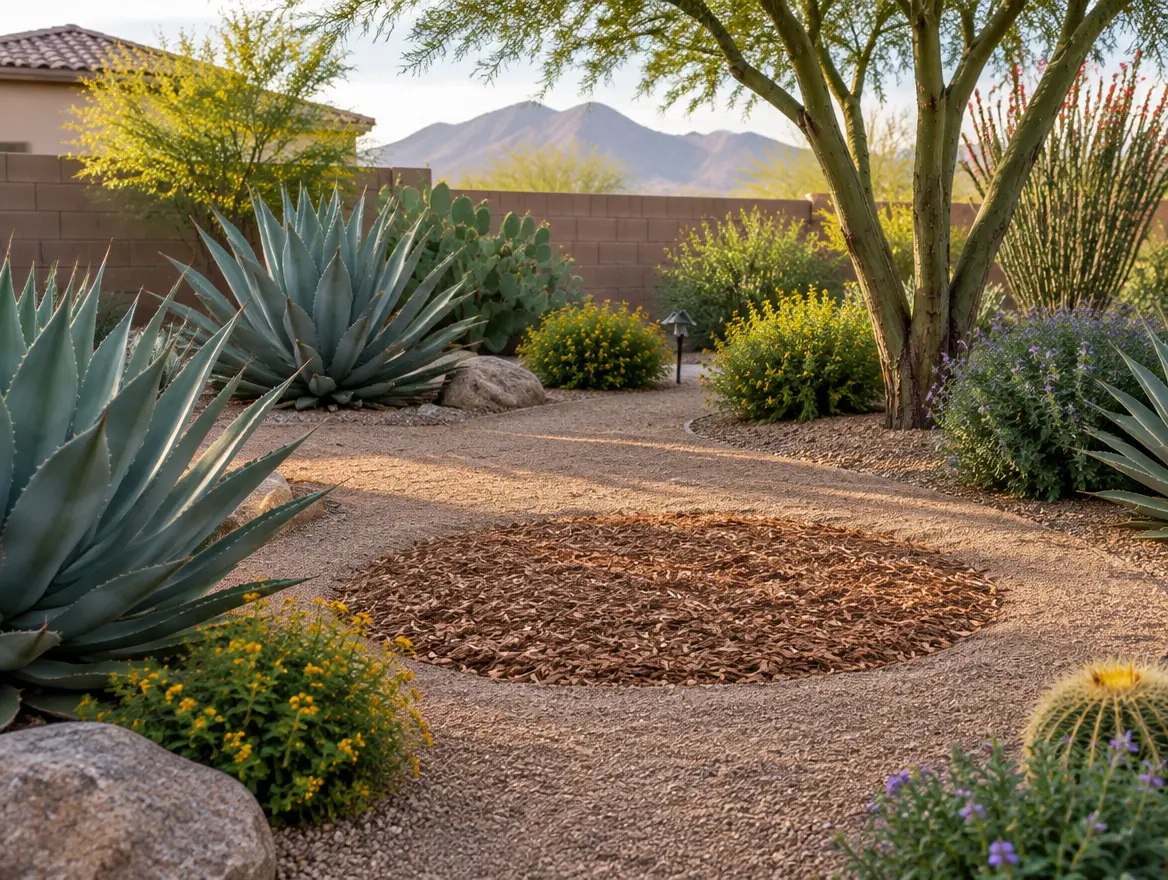
What is stump grinding and how does it work?
The grinder works back and forth across the stump, taking off a little wood with each pass until it reaches the depth you need. Typical steps on an East Valley job:
- Utility locate. Grinding is digging, so buried utilities need to be marked through Arizona 811 before work begins.
- Irrigation check. Drip lines, bubblers and valves often run right next to trunks in desert landscapes. We look for them and ask you to point out anything you know of.
- Grind. The stump and large surface roots are ground below grade. Rocks and gravel around the stump are raked back first where possible.
- Clean up. Grindings are raked into the hole or hauled away, whichever you prefer.
Compact grinders can fit through many standard side gates, so backyard stumps behind block walls are usually reachable. If a tree still needs to come down first, see tree removal. Pairing the two in one visit is often the simplest option.
How deep do you grind a stump?
The right depth depends on what's going in the spot next:
| Your plan | What it usually needs |
|---|---|
| Cover with gravel or decomposed granite | A standard grind a few inches below grade |
| Lay sod or seed | Deeper grind, chips removed, clean topsoil added |
| Replant a tree nearby | Plant offset from the old stump, or grind deeper and replace chips with soil |
| Pavers, concrete or a pool deck | Deep grind, surface roots chased out, chips removed so the base can be compacted |
Caliche, the cemented calcium carbonate layer common in East Valley soils, sometimes limits how deep a grind can go. Hitting it isn't a problem for gravel or turf, but it's worth knowing if you're planning a new tree in the same spot. Planting holes in caliche need good drainage, and University of Arizona Cooperative Extension has guidance on planting in caliche soils.
Should I grind the stump or leave it?
Reasons homeowners in Gilbert, Queen Creek and San Tan Valley usually choose to grind:
- Resprouting. Sissoo is notorious for sending up suckers from its roots and stump after removal. Eucalyptus and some mesquite do the same. Grinding removes the stump that feeds those sprouts.
- Termites. Subterranean termites are common in the Valley, and a decaying stump close to the house is an easy food source.
- Looks and HOA rules. Many HOAs expect front yards to be kept clean. A stump left after a removal may draw a notice.
- Safety. Low stumps hidden in gravel are easy to trip on and can damage mowers.
- Re-landscaping. You can't lay pavers, turf or a new planter over a stump.
When leaving it is fine: a stump at the back of a large lot where nobody walks, from a species that doesn't resprout, and with no plans for the space. Some people even keep large mesquite stumps as a natural seat or plant stand.
How much does stump grinding cost in the East Valley?
What moves the price of stump grinding:
- Diameter. Measured across the widest part at ground level. A big eucalyptus or old mesquite stump takes much longer than a young palo verde.
- Wood type. Dense desert hardwoods like mesquite and ironwood grind slower than softer woods.
- Surface roots. Sissoo roots that run under pavers or toward a pool add time if you want them chased out.
- Depth. A standard grind for gravel costs less than a deep grind for concrete or a replant.
- Access. Stumps behind narrow gates, on slopes or surrounded by hardscape need a smaller machine and more care.
- Quantity. Grinding several stumps in one visit lowers the cost per stump.
Adding grinding to a tree removal on the same day is usually the most cost-effective route. See all price factors in our tree service cost guide, or request a free estimate.
What do I do with the hole after stump grinding?
Some practical tips for the weeks after grinding:
- Expect settling. Grindings and loose soil sink as they decay and get watered. Plan to add a little more fill later.
- Fix the irrigation. Cap or move the drip emitter that watered the old tree. Otherwise you'll be watering an empty spot, and the soggy grindings can draw fungus gnats.
- Reuse the chips. Leftover grindings make a decent mulch around shrubs, kept a few inches away from trunks and stems.
- Watch for sprouts. With sissoo or eucalyptus, cut back any shoots that come up from remaining roots promptly. They weaken with repeated cutting.
- Plant a replacement wisely. Choose a desert-adapted tree sized for the space. Lists from University of Arizona Cooperative Extension and the Arizona Municipal Water Users Association are good places to start.
Want help deciding what to plant, or have trees that need shaping before next summer? See tree trimming.
Our stump grinding process
- Send photos or callCall 480-779-4349 or use the estimate form. A photo with something for scale, like a shoe, helps us size the stump.
- Written quoteWe confirm stump size, depth and access, and give you a clear upfront price with no hidden fees.
- Locate and prepUnderground utilities are marked through Arizona 811, and irrigation lines near the stump are identified.
- Grind and clean upThe stump and surface roots are ground below grade, then grindings are raked into the hole or hauled away.