When should a tree be removed instead of trimmed?
Removal is permanent, so it should be a considered decision. Common reasons East Valley trees come down:
- Decline or death. Palo verdes attacked by palo verde root borers, mesquites with major trunk decay, or trees that never recovered from a hard freeze or a split.
- Structural defects. Cracks through the trunk, co-dominant stems splitting apart, large cavities, or a sudden new lean after monsoon rains have softened the soil.
- Root damage. Aggressive surface roots, especially from sissoo trees, lifting pavers, cracking pool decks and invading irrigation and sewer lines.
- Wrong tree, wrong place. A eucalyptus planted ten feet from the house, or a mesquite crowding a two-story roofline, may never be safely managed by pruning alone.
- Remodels. Pool installs, casitas, RV gates and hardscape projects.
A tree that is merely overgrown or messy is often a trimming job, not a removal. We'll give you an honest recommendation either way. For more background on judging tree risk, the ISA's TreesAreGood.org is a good starting point.
How do you remove a tree in a tight backyard?
Very few Gilbert or Chandler backyards have room to drop a tree in one piece. Most removals are done as a sectional takedown:
- Plan the drop zones. We identify where each piece can safely land or be lowered, away from the pool, patio cover, AC units and the neighbor's side of the wall.
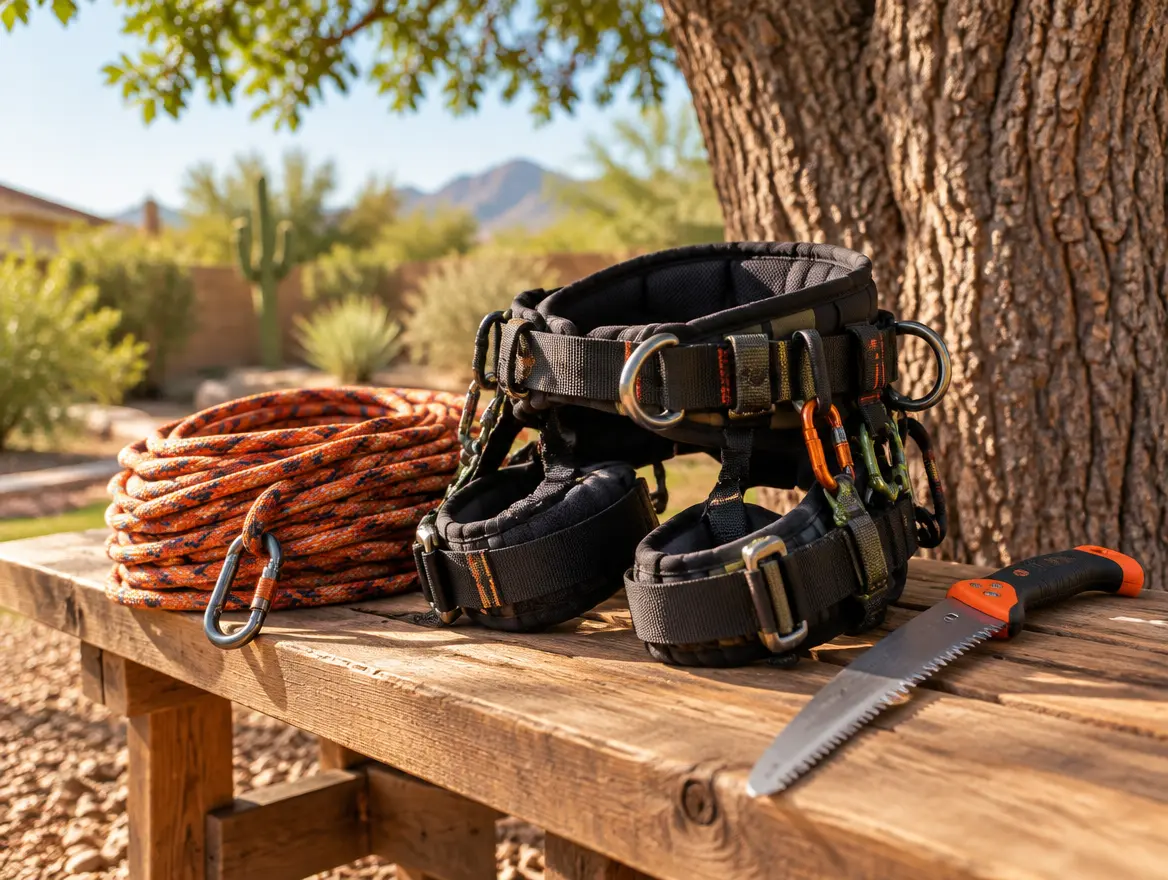
- Remove the canopy. Limbs are cut in manageable pieces. Anything heavy over a structure is tied off and lowered with rigging instead of dropped.
- Take down the trunk. The trunk is cut in short rounds from the top down until it can be safely felled or lowered.
- Get it out. Brush and wood go out through the side gate, which is often only a few feet wide in newer subdivisions. Plywood or mats protect turf and pavers where needed.
Caliche and the shallow root plates common in irrigated desert landscapes don't change the takedown much, but they do matter for what comes next. If you want the stump gone, see stump grinding. Be sure to ask about it when you get your quote so it can be done in the same visit.
Do I need a permit or HOA approval to remove a tree?
Rules differ between Gilbert, Mesa, Chandler, Queen Creek, Pinal County (San Tan Valley) and Florence, and they change over time. We don't want to give you a wrong answer, so here's how to check:
- HOA. Many master-planned communities require architectural approval to remove front-yard trees and may require a replacement tree from an approved list. Ask your management company before the work is scheduled.
- Town or county. Trees in the public right-of-way, on commercial sites with approved landscape plans, or native plants protected under Arizona law may have their own requirements. Call your town's planning or code compliance office if you're unsure.
- Utilities. If the tree is near overhead lines, contact SRP or APS first.
- Neighbors. If the trunk sits on or across a shared wall line, talk with your neighbor before work begins.
Our HOA customers often ask us for a written scope they can attach to an architectural request. We're happy to provide one with your quote. For community-wide work, see HOA and commercial tree care.
How much does tree removal cost in Gilbert and the East Valley?
Two trees that look the same size can be very different jobs. What actually drives a removal price:
- Height, trunk diameter and wood weight. Mesquite and ironwood are dense and heavy. Eucalyptus and sissoo get big fast.
- What's underneath. Pools, patio covers, roofs, AC units and block walls mean more rigging and slower, controlled lowering.
- Access. An open front yard with driveway access is fastest. A backyard behind a narrow gate means everything is cut small and carried out.
- Condition. Dead or storm-split trees can be unpredictable and need extra care.
- Stump and roots. Grinding is priced separately so you can choose. Sissoo and eucalyptus often call for extra root work.
Clean-up and haul-away are included, and the price on your written quote is the price you pay. See more on what drives cost in our tree service cost guide, or request a free estimate.
What happens to the stump and roots after removal?
A standard removal leaves a low, flush-cut stump. From there, you have three options:
- Leave it. Cheapest, but stumps of resprouting species keep pushing up shoots, and a stump in a gravel yard is a trip hazard.
- Grind it. A stump grinder chews the stump and main surface roots into mulch below the surface. Then you can top it with soil or decomposed granite and move on. See stump grinding.
- Grind plus surface-root work. Common with sissoo, where roots have run under pavers or toward the pool. See sissoo tree removal.
One East Valley-specific note: drip lines and irrigation valves often run right beside tree trunks. Mark your irrigation and any low-voltage lighting before grinding day, and cap the emitter that fed the old tree so you aren't watering an empty spot. Grinding involves digging, so buried utilities also need to be located through Arizona 811 before work begins.
Why hire AZ Grown Tree Care for tree removal?
Before you hire anyone to take down a tree, ask for two things in writing: proof of liability insurance and a written scope that says what's included (stump, haul-away, clean-up). A legitimate company won't hesitate to provide them. Here's ours:
- Insurance: general liability coverage through Western World Insurance Co. ($1,000,000 per occurrence, $2,000,000 aggregate)
Be cautious of anyone who knocks on doors after a monsoon, asks for full payment before starting, or can't explain how they'll protect your wall and pool. A good removal plan is specific: where the pieces will land, what gets rigged and lowered, how the wood leaves your yard, and what condition the yard will be in when the crew drives away.
We work throughout the Southeast Valley, including Gilbert, Queen Creek, San Tan Valley, Mesa, Chandler and Florence. If a tree came down in a storm, see monsoon and storm cleanup.
Our tree removal process
- Call or request a quoteReach Dale at 480-779-4349 or through the free estimate form. Photos of the tree and the access path help.
- Site assessmentWe check the tree's condition, what's underneath it, access through gates, and any utility, HOA or neighbor considerations.
- Written quoteYou get a clear upfront price, with stump grinding listed as an option, and no hidden fees.
- Controlled takedownThe tree comes down in planned sections, with heavy pieces lowered by rope, protecting walls, pools and landscaping.
- Haul-away and clean-upWood and brush are removed, the site is raked and blown clean, and the stump is ground if you chose that option.