
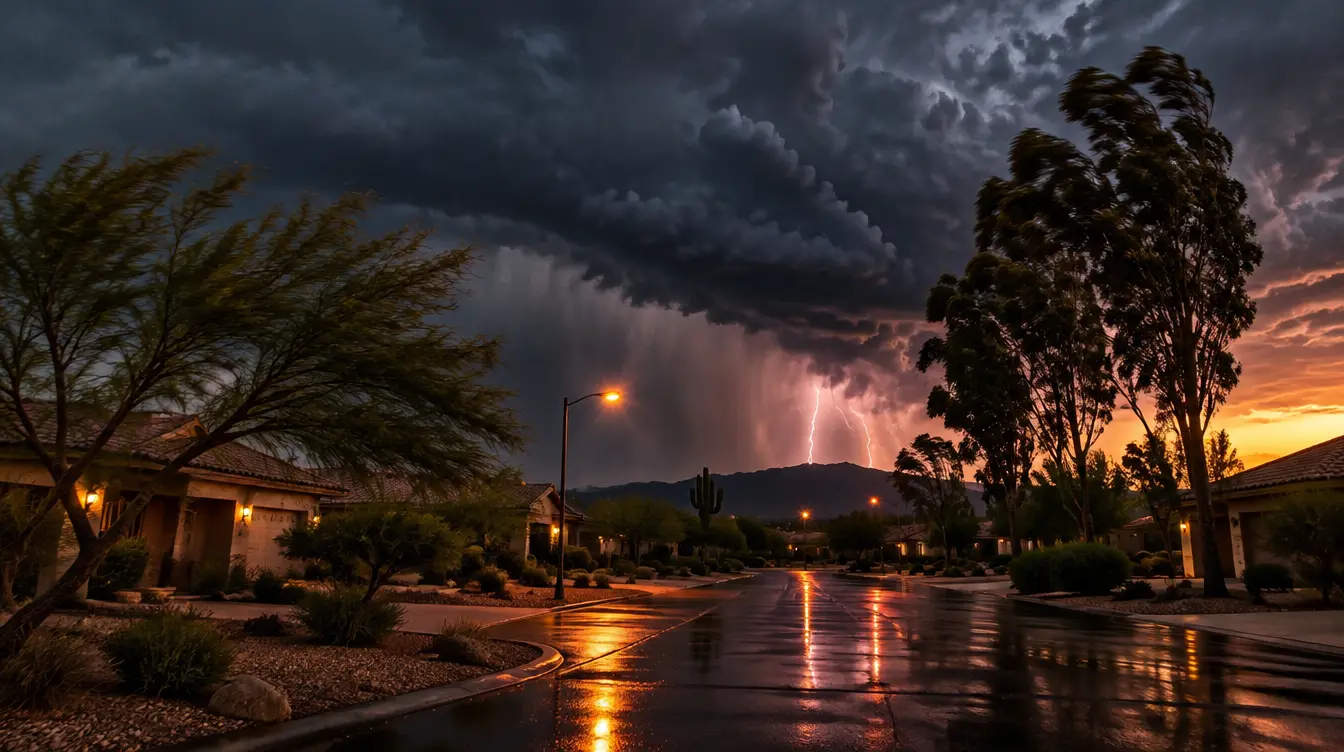
When should I start getting my trees ready for monsoon?
Monsoon prep is easiest as a short seasonal routine rather than a last-minute scramble:
| When | What to do |
|---|---|
| Late winter to spring | Structural pruning on mesquite, palo verde, ironwood and other desert trees. Correct weak unions and crossing limbs. |
| Spring | Walk the yard and note dead limbs, cracks, leaning trees and heaving soil. Schedule a professional look at anything large. |
| Late spring to early summer | Light canopy thinning on dense trees. Trim palms of dead fronds and seed stalks. Check irrigation emitters. |
| During monsoon | Remove broken or hanging limbs promptly. Avoid heavy pruning in peak heat. |
| After the season | Look for split unions, root lifting and leaning trees that shifted during storms. |
The City of Chandler's storm-damage guidance notes that microbursts cause the most damage of any monsoon wind event. You cannot control the storm, but you can control how prepared your trees are when it arrives.
Should I thin my trees before monsoon?
University of Arizona Cooperative Extension notes that some thinning of internal branches may be necessary to prevent storm injury from the sail effect of heavy canopies, while also cautioning never to remove more than one quarter of the canopy at one time. AMWUA recommends confining cuts to the outer 20 percent of the canopy and warns that lion-tail pruning makes branches more vulnerable to breaking in heavy winds.
The City of Chandler's guide quotes Dr. Chris Martin of Arizona State University on why: trees distribute wind stress across their whole structure, and when we interfere with that, failures follow.
Good pre-monsoon thinning looks like
- Selective cuts back to a side branch, spread evenly through the crown.
- Reducing long, heavy end-weighted limbs, especially over roofs and patios.
- Leaving inner foliage in place.
- No topping and no stubs.
Our tree trimming crews follow this approach for every species we work on.
How should I water my trees before and during monsoon?
Irrigation is one of the most overlooked storm factors in East Valley yards. The City of Chandler's storm-damage guide explains that excessive watering reduces wood density, shrinks the root system relative to the canopy, and that moist or saturated soil near the trunk is unstable in wind. It recommends placing emitters at the drip line, where most feeder roots are.
- Deep, not frequent. Desert-adapted trees do best with long, slow soaks spaced out, rather than short daily cycles.
- Move emitters outward. Emitters installed when a tree was young are often still hugging the trunk years later.
- Watch caliche. Shallow caliche layers can trap water and keep roots shallow. If water ponds or roots seem to sit right at the surface, ask about it.
- Turf trees. Trees growing in lawns often get frequent shallow water from sprinklers and may need a separate deep-watering plan.
- After rain. Pause or cut back irrigation after a soaking storm.
Watering advice varies by species and soil. Your water provider and AMWUA publish seasonal guidance that is worth checking each spring.
What warning signs should I look for before storm season?
ISA's TreesAreGood site publishes a "Recognizing Tree Risk" resource for homeowners, and the warning signs it covers line up with the damage seen after East Valley storms. Prioritize trees that could hit something important if they failed: your house, a pool enclosure, a vehicle, a play area or a neighbor's yard.
- Dead wood: brittle limbs with no leaves during the growing season.
- Cracks and splits: especially where two main stems meet.
- Weak unions: tight V-shaped crotches with included bark.
- Decay: fungal growth, cavities, oozing or soft wood near the base.
- Root problems: lifting soil, cut roots from trenching or hardscape work, or a recent lean.
- Hangers: broken branches caught in the canopy from earlier wind.
For a deeper walk-through, read signs a tree needs to be removed. If you see any of these on a large tree, an inspection before monsoon costs far less stress than cleanup after.
What about palms and trees near power lines?
Mexican fan palms and date palms are everywhere in Gilbert, Chandler and Mesa, and dead fronds plus fruit stalks are a common monsoon mess. University of Arizona Cooperative Extension's palm publication notes that green, living fronds should generally be left in place, because over-pruned palms develop weakness and often break in wind. Learn more in our guide to palm trimming vs. skinning or on our palm tree trimming page.
Power line safety
- Treat every overhead line as energized.
- Utilities generally handle clearance on their distribution lines. Contact yours for those trees.
- Work near the service line to your house should be done by trained, insured professionals.
If a storm does damage a tree
Stay clear of downed lines, photograph the damage, and contact your insurer about coverage, which varies by policy. Our emergency tree service handles storm cleanup across the East Valley. Call 480-779-4349.
Frequently asked questions
When does monsoon season start in Arizona?
Is it too late to trim trees once monsoon has started?
Which East Valley trees are most likely to fail in monsoon storms?
Does thinning a tree make it safer in wind?
Should I stake my tree for monsoon?
Who handles trees touching power lines?
Can you inspect my trees before monsoon?
Sources & further reading
- City of Chandler: Reduce the Risk of Storm Damage
- AMWUA: Five Common Summer Landscape Mistakes
- University of Arizona Cooperative Extension: July Gardening Guide (Pima County)
- University of Arizona Cooperative Extension: Arizona Landscape Palms and their Management (AZ2021)
- ISA TreesAreGood: Recognizing Tree Risk