How often should palm trees be trimmed in Gilbert?
How often your palm needs attention depends on the species, its height and how messy it is:
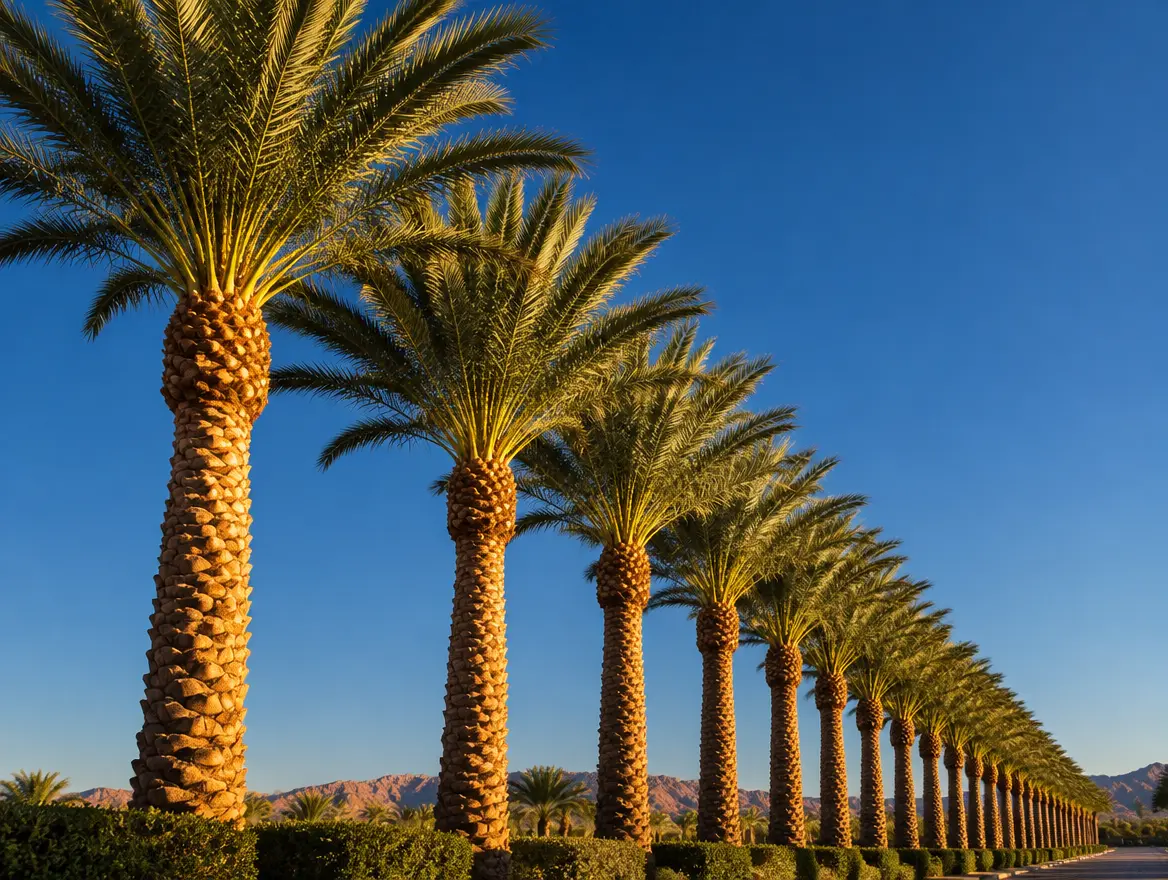
- Mexican fan palm (Washingtonia robusta): tall, fast-growing and very common across the East Valley. Dead fronds build up into a skirt if not removed, and seed stalks drop debris into pools and yards.
- Date palms (Phoenix dactylifera) and Canary Island date palms: heavy fronds with sharp spines and large fruit clusters. University of Arizona Extension notes that old fronds and fruit drop on date palms require considerable cleanup and that pruning can get costly as the palm grows taller.
- Smaller palms like Mediterranean fan palm may only need occasional grooming.
Freeze-damaged fronds are a special case. Extension recommends waiting until the risk of cold injury has passed before removing them, because even damaged fronds help protect the bud through the rest of winter.
Our palm tree trimming crews serve Gilbert, Mesa, Chandler, Queen Creek, San Tan Valley and Florence.
What is the difference between palm trimming and skinning?
| Trimming | Skinning | |
|---|---|---|
| What is removed | Dead fronds, flower and fruit stalks | Old leaf bases (boots) on the trunk |
| Purpose | Safety, cleanliness, pest and fire-fuel reduction | Appearance (smooth trunk look) |
| How often | Usually once a year | Rarely, if ever |
| Risk to palm | Low when done correctly | Can wound the trunk and spread disease |
University of Arizona Cooperative Extension's palm publication puts it plainly: peeling or skinning trunks to remove petiole remnants and leaf bases is typically unnecessary and may wound the pseudobark, cortex and even the central cylinder, and transmit disease. Because palms lack the growth layer that lets other trees close wounds, those injuries stay permanent.
The gentler alternative is to remove only leaf bases that fall or pull away easily, which Extension describes as ideal.
Why is over-trimming bad for palm trees?
The tight "pineapple" or "feather duster" cut, where nearly every green frond is removed, is common in neighborhoods but hard on the palm. Here is what Extension recommends instead:
- Remove dead fronds, plus flower and fruit stalks. Leave green fronds whenever possible.
- Stay below nine and three. Do not remove any living fronds above the horizontal line through the crown.
- Limit the total. A good rule of thumb is no more than 25 percent of the living canopy in a season, pruning no more than once per season.
- Leave yellowing fronds showing potassium or magnesium deficiency, so the palm can move those nutrients to newer growth.
An over-pruned palm can show a thinning, pencil-shaped trunk section where it was stressed. That narrow spot can be a weak point for years. In monsoon country, a fuller crown is a stronger crown. See our monsoon prep checklist for more.
How should a palm be trimmed safely?
Tall palms are often trimmed from a lift or by a trained climber, depending on height and access. Either way, these practices protect the tree:
- No climbing spikes. Extension notes that spike wounds are permanent in palms and can let disease in.
- Clean tools. Extension lists Thielaviopsis rot and Fusarium wilt among palm diseases that can spread on pruning tools. Extension describes Fusarium wilt as fatal with no treatment, and it has been identified in Arizona on palms including Mexican fan palms, so disinfecting saws between trees matters.
- Clean cuts near the trunk. Fronds are cut at the petiole close to the trunk, without slicing into it.
- Debris control. Spiny date palm fronds and heavy seed clusters are lowered or dropped into a cleared zone away from pools, roofs and cars.
- Full cleanup. We haul everything away. It is included in every quote.
Palm trimming at height is not a DIY job. Ladders and chainsaws near a 40-foot trunk are a dangerous combination.
Is it OK to leave a palm skirt on in the East Valley?
University of Arizona Cooperative Extension describes the skirt, or shag, as dead lower fronds that persist on the trunk. It notes a skirt may be kept for trunk protection or historic character, or pruned to reduce the hazard of falling debris and improve appearance.
Reasons many homeowners remove the skirt
- Large thatches can fall in monsoon winds.
- Dry fronds are flammable.
- Skirts can shelter rodents, birds and insects close to the house.
- Many HOAs in Gilbert, Chandler and Queen Creek have maintenance standards for palms. Rules vary, so confirm with your HOA.
Removing an old skirt is different from skinning. We remove dead fronds without peeling healthy leaf bases off the trunk. For HOA communities managing many palms, our HOA and commercial tree care page explains scheduled service. Palms are priced after an on-site look, and you get the price in a written quote.