
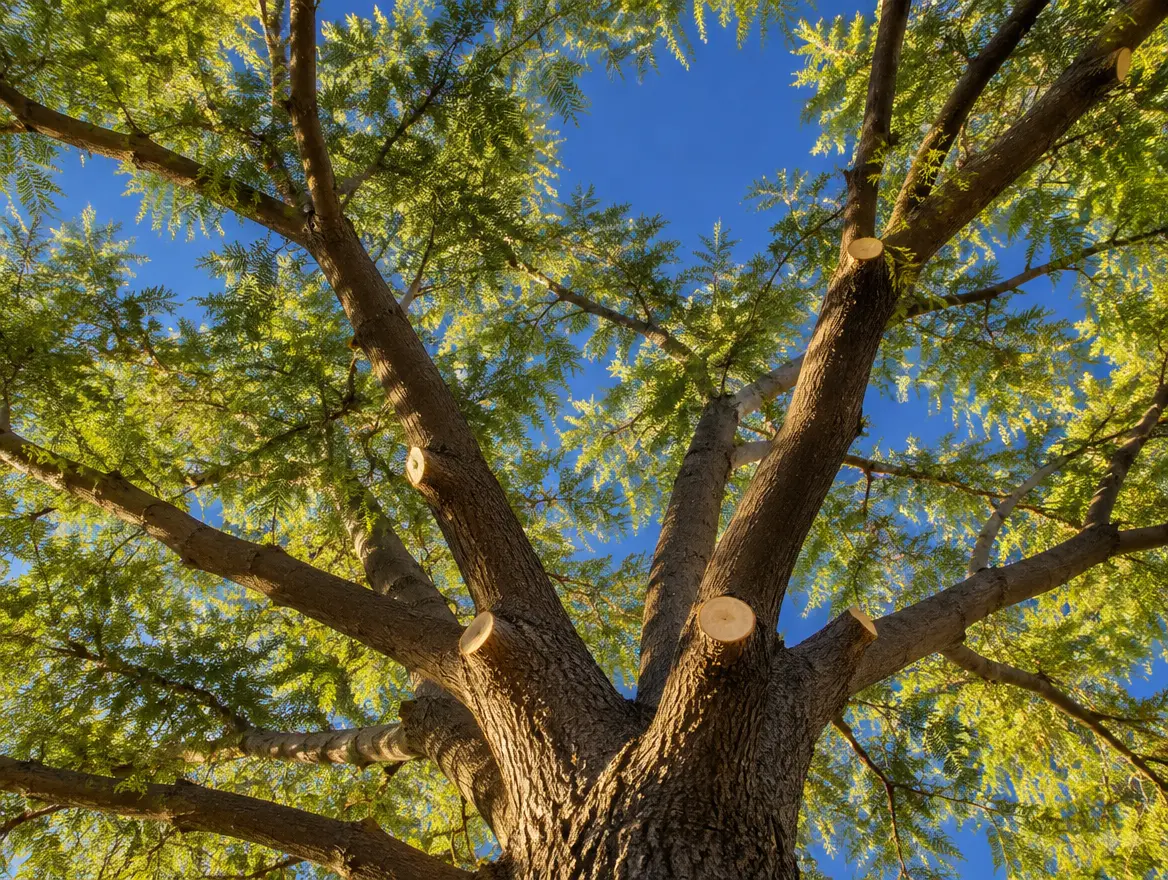
What is the best month to prune a mesquite tree in the East Valley?
Mesquites in local landscapes (native velvet mesquite, Chilean and hybrid South American mesquites, and honey mesquite) grow fast when irrigated, and that growth is what you are managing. Here is how we think about the calendar:
- Late winter to spring (roughly February to May): the main window for structural work, which means choosing strong main limbs, removing crossing or rubbing branches, and correcting codominant stems. Arizona Municipal Water Users Association guidance notes it is better to prune just before growth starts in spring.
- Late spring to early summer: a light thinning of overly dense canopies to reduce the sail effect before monsoon. University of Arizona Cooperative Extension notes that some thinning of internal branches can help prevent storm injury in heavy-canopied trees.
- Mid-summer: mesquite tolerates summer pruning and closes wounds quickly in the heat, but this is not the time for big cuts. Heavy removal exposes bark to sunburn and stresses the tree when it is already working hardest.
- Anytime: dead, broken or hanging limbs should come out as soon as you see them, especially over driveways, patios and play areas.
Not sure where your tree falls? Our tree trimming service starts with a look at structure, not just size.
Why do mesquite trees blow over during monsoon?
The City of Chandler's storm-damage guide lists pruning practices, overwatering and weak branch attachments among the main reasons trees fail in high winds. For mesquite specifically, the same failure patterns come up again and again:
- Too much canopy, too little root. Turf-style irrigation pushes fast top growth. The City of Chandler guide notes that chronic overwatering lowers wood density and shrinks the root system relative to the canopy.
- Lion-tailing. Stripping interior branches and leaving tufts at the ends moves weight outward. AMWUA calls this out directly as making branches more vulnerable to breaking in heavy winds.
- Included bark. Two stems growing tightly together trap bark between them and form a weak seam that can split under load.
- Wet soil at the trunk. Emitters left close to the trunk keep soil soft right where the tree needs firm footing. Move emitters out toward the drip line as the tree grows.
Monsoon microbursts can still take down a well-pruned tree, but good structure and sensible watering stack the odds in your favor. See our monsoon tree prep checklist for the full list.
How much of a mesquite tree can you safely cut off?
Leaves are how a mesquite makes food. Over-pruning forces the tree to push out a flush of weakly attached water sprouts, which then need even more pruning, and the cycle repeats. AMWUA also recommends confining most cuts to the outer portion of the canopy rather than gutting the interior.
What a good mesquite trim looks like
- Thinning cuts back to a healthy side branch or the trunk, made just outside the branch collar, with no stubs.
- Interior branches mostly left in place so weight stays evenly distributed.
- Crossing, rubbing and dead limbs removed first.
- Clearance from roofs, walls and walkways, kept to what the space actually needs.
- No pruning paint or sealer. University of Arizona Extension advises against sealers on pruning cuts.
What to avoid
Topping (cutting the top back to stubs), heavy lion-tailing, and raising the canopy so high that the tree becomes an umbrella on a stick. If a previous crew left your mesquite this way, it can usually be retrained with a few careful seasons of corrective pruning.
Is it bad to trim a mesquite tree in the summer heat?
University of Arizona Cooperative Extension notes that mesquite, palo verde and eucalyptus can be pruned in summer because they heal quickly in hot weather. The key word is prune, not overhaul. AMWUA's summer landscape guidance warns that thinning exposes inner branches to sun damage.
In practice, summer work on mesquite in Queen Creek, San Tan Valley or Florence usually means:
- Removing storm-broken or hanging limbs after a monsoon event.
- A light reduction of an overly dense canopy ahead of storm season.
- Clearing branches off a roofline, wall or pool fence.
The City of Chandler's storm guide also advises avoiding foliage removal during seasons when sunburn can result. If your tree is visibly stressed (thin, yellowing or wilting canopy), wait. Water it deeply and slowly, let it recover, and prune once temperatures ease.
Seth B., one of our customers, summed up what most homeowners want from a trim: "Quick to schedule, efficient, great-looking result, fair price." Good timing is a big part of getting there.
Should I hire an arborist or trim my mesquite myself?
University of Arizona Cooperative Extension says large trees are usually best left to professionals and suggests a qualified tree professional when in doubt. A few signs the job is beyond DIY:
- The limb is thicker than your wrist or more than a few feet over your head.
- Branches are near service drops or overhead lines. Never prune near energized lines yourself; contact your utility.
- The tree leans toward the house, a wall or a neighbor's yard.
- You see cracks, a split between two main stems, or decay at the base.
When we trim a mesquite, you get an upfront written quote with no hidden fees, and cleanup and haul-away are included. You can read more about the company on the about page, and you can request a free estimate or call 480-779-4349.